
Activate Your Company's Knowledge with AI
A trusted foundation to guide decisions, respond with context, and run processes autonomously, creating agents and flows to generate scale.


Before you scale agents, structure the context they will use
Companies already have AI models, data, systems, documents, and digital applications. The problem is that, often, these assets do not share a common knowledge layer. As a result, AI responds but does not always understand the business; it automates interactions but still depends on scattered context; it generates speed but can amplify inconsistencies when there is no governance.
ContextFlow works as a semantic layer that organizes corporate knowledge, connects relevant sources, structures rules, and makes context available to agents, products, and digital journeys. In practice, it builds the foundation for AI to stop operating on isolated prompts alone and start working with governed, traceable context connected to the reality of the business.

HOW WE IMPLEMENT AI AT SCALE
To sustain digital growth, you have to stop treating the tech stack as a set of fragmented tools and position it as a structuring asset of the business. That's how we turn IT into an enabling foundation to scale results and innovation continuously.
PILOT MINDSET


PLATFORM MINDSET
Bringing AI into daily workflows.
Deep AI integration into data ingestion, storage, and governance.
Stable environments where teams innovate with confidence.
The Pillars of Context Flow
Connects data, documents, systems, history, and rules so AI factors in the reality of the business, not just the content of a prompt.
Coordinates models, integrations, policies, and decision criteria in a logic layer, reducing variation and increasing the consistency of responses.
Turns context and decision into execution, letting agents support processes, trigger tools, and integrate with the company's systems.
Monitors interactions and identifies recurring failures, content gaps, and opportunities to improve.
Applies permissions, auditing, version control, and security criteria for enterprise AI use.
Benefits for Companies That Want to SCALE results with AI
Reduce divergent interpretations by structuring a shared base of knowledge, rules, and trusted sources.
Cut the work of searching, comparing, and interpreting information scattered across documents, systems, and business areas.
Apply permissions, traceability, versioning, and control criteria to reduce risk in initiatives involving agents and automations.
Connect AI to the real workflows of the business, keeping responses, decisions, and actions aligned with corporate processes.
Build a context foundation that can be reused by new agents, products, journeys, and applications over time.
“Buscamos sempre por conexões que nos ajudem a entregar mais valor para nossos parceiros, oferecendo soluções cada vez mais rápidas e eficientes.”
Multi-Layer Agent Architecture
ContextFlow organizes the relationship between knowledge, decision, and execution through a layered architecture. This structure lets applications and products operate in a governed way, with integration into the company's systems and traceability mechanisms.
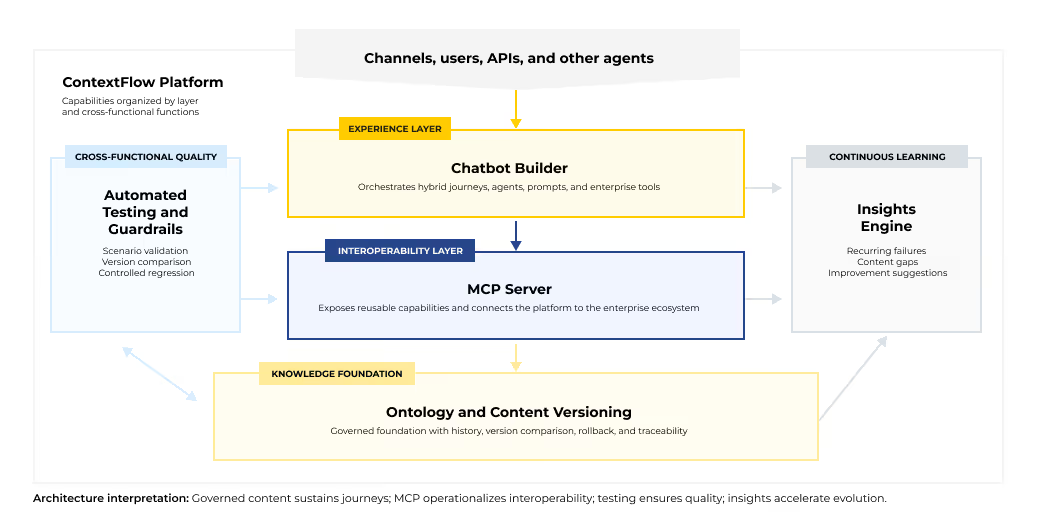
Capabilities
ContextFlow was designed to operate as a central platform for orchestrating intelligent experiences. Its capabilities include:
Intelligent agent creation
Build guided or autonomous agents to support service, operations, productivity, and decision journeys.
Visual workflow building
Model AI flows no-code, connecting steps, rules, integrations, and actions into complete journeys.
Contextualized corporate chats
Create conversational experiences with access to internal data, documents, and enterprise systems.
Integration with APIs and data sources
Connect applications, services, databases, internal platforms, and external sources relevant to the flow.
RAG and tool-enabled agents
Supports the retrieval of relevant information and the execution of actions connected to the enterprise environment.
Use of multiple models and architectures
Adopt different models and approaches according to privacy, performance, cost, and quality requirements.
Context and memory orchestration
Expand AI's responsiveness with context, information-retrieval, and interaction-continuity mechanisms.
White-label and embedding in your own channels
Take the intelligence built on the platform into the company's applications, portals, journeys, and proprietary channels.
